
Creator marketing
How Wispr Flow Scaled to 500+ Creator Ads a Month
How Wispr Flow scaled to 500+ creator ads a month, and what 1,668 AI answers reveal about its YouTube visibility.
Ask an AI assistant about Wispr Flow, and half the time the answer cites a creator’s YouTube video. That is no accident. The voice dictation company puts creators at the center of its growth, with head of content Hector Serrano running a program of 500–600 creator ads a month with about 50 creators. Alongside those ads, it partnered with creators to publish videos for their own audiences, putting a working demo in front of people who already turned to them for advice.
The second approach left a longer trail. At Hypervoice, our team analysed a year of AI search visibility data for Wispr Flow. Creator videos on YouTube are now the most-cited source in AI answers about the brand, ahead of its own website.
Wispr Flow’s Creator Partnership Strategy
Morning Brew co-founder Alex Lieberman shared how he uses Wispr Flow in a LinkedIn post that disclosed the partnership. He showed how he drafts messages, prompts Claude, and captures thoughts after meetings. For other founders, those examples made it easy to see where voice dictation might fit into their own day.
On YouTube, Wispr Flow sponsored creators across a wide range of channels. In one of those partnerships, creator Moe Lueker opened by dictating the same sentence into his computer’s built-in dictation and Wispr Flow. The comparison turned a product claim into something viewers could judge for themselves.
How Creator Marketing Became a Growth Channel
Serrano built Wispr Flow’s paid ad program around a small roster, focused on creators whose ads brought new users who stayed.
How Wispr Flow Scaled What Worked
Serrano started with about five creators, each chosen to bring something the existing ads lacked, such as a different audience, format, or market. As the roster grew, Wispr Flow paid creators a share of the ad spend behind their videos. Media buyer Eric Zaworski described looking past installs to see whether new users kept dictating after they started.
Creator partnerships on LinkedIn and YouTube served a different purpose. They gave creators room to show the product in their own workflow. The two approaches reinforce each other: a creator publishes a walkthrough for their audience, and the brand puts ad spend behind a demo that has already drawn interest.
How the Videos Surfaced in AI Search
Search and AI answers gave those videos a second life. Our team analysed 1,668 AI answers about Wispr Flow, covering 686 prompts in 91 countries. YouTube came out on top.
FIGURE 01 · WISPR FLOW
YouTube led citations in AI answers about Wispr Flow
Share of all 10,186 links cited in the sample
YouTube is the most-cited domain. It accounts for 18.9% of all cited links, ahead of wisprflow.ai at 15.3% and far ahead of Reddit at 2.5%. Half of all AI answers about Wispr Flow cite at least one YouTube video.
Video adds what a product page can’t. When AI cites a creator’s video, it pairs it with Wispr Flow’s own pages 91% of the time. The site supplies the facts; the video supplies the demo and an independent view.
Video matters most when buyers are still choosing. On brand searches, AI cites wisprflow.ai in 91% of answers and YouTube in 31%. On category questions such as “speech to text app” or “dictation app,” the site drops to 57% and YouTube rises to 50%. In 16% of those category answers, a creator’s video is cited and Wispr Flow’s own site is not.
The effect built quickly. AI citations of Wispr Flow rose about fourfold between February and May 2026, with YouTube carrying 60% to 80% of them every month, while AI mentions grew from about 100 to 2,800 over the year.
Which Videos Worked
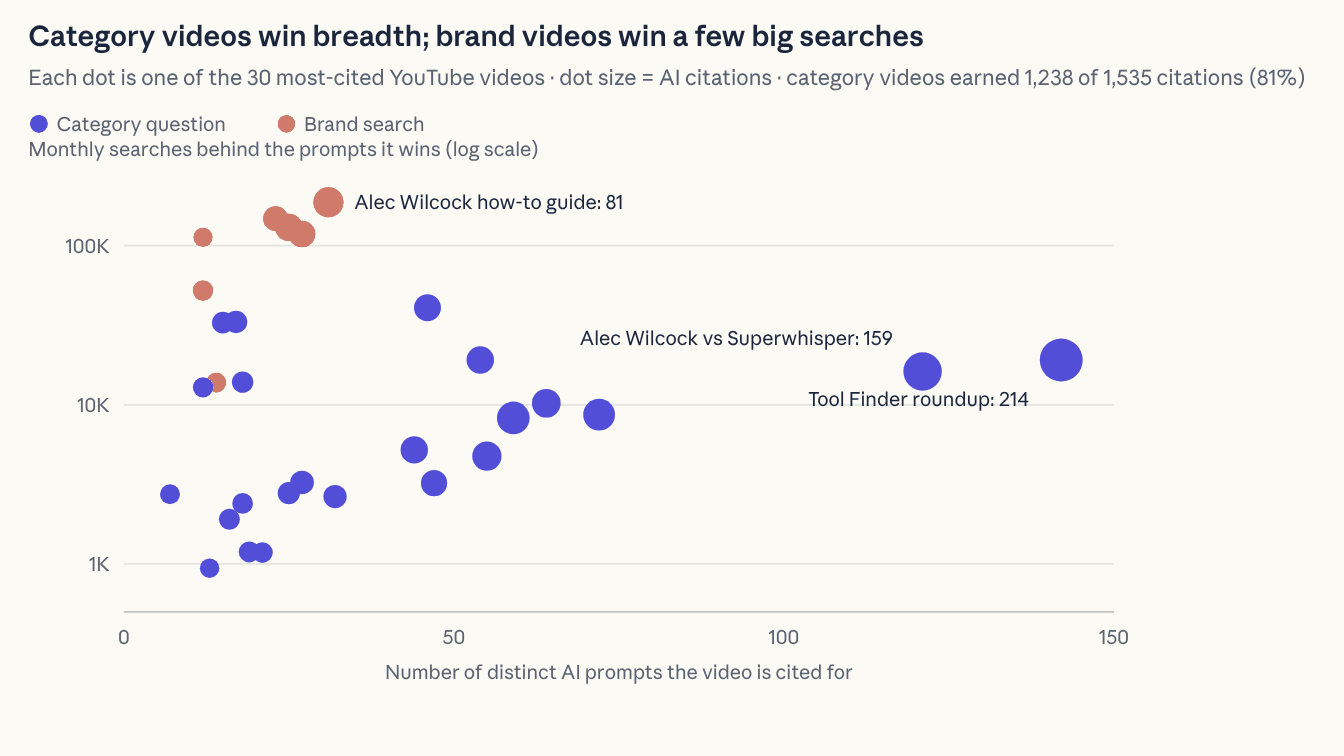
We mapped the 30 videos AI engines cite most for Wispr Flow by two things: how many different questions each one answers, and how much search demand sits behind those questions. Two kinds of video emerged.
FIGURE 02 · WISPR FLOW
Category videos answered a wider range of questions
Each dot is a YouTube video. Dot size represents AI citations.
 View full-size chart ↗
Category videos do most of the work. The 23 videos that win questions like “dictation app” or “speech to text software” earned 1,238 of the 1,535 citations (81%). Each is cited for about 41 different prompts on average. Tool Finder’s “Best Voice Typing Apps in 2026” alone is cited for 142, and Alec Wilcock’s “Wispr Flow vs Superwhisper” for 121.
The learning: go beyond brand videos. The seven videos that win “wispr flow” searches sit behind about 76% of the search volume in this set, yet earn only 19% of citations. Brand content reaches people who already know the name, and it does that well. Alec Wilcock’s how-to guide sits behind 188K monthly searches. But it is cited for just 31 prompts, because brand searches are a narrow set of questions. To show up where new buyers are deciding, brands need creators answering the category questions too.
For CMOs, the lesson is to fund breadth, not just the brand moment. A comparison or “best of” video that answers many buyer questions keeps your product on the shortlist long after a brand tutorial has done its job.
Beyond the Paid Campaign
A creator researching a dictation comparison can come across an existing walkthrough, try the tool, and make a video for a different audience. Over time, the same product shows up in tutorials, comparisons, and recommendations long after the original collaboration.
Wispr Flow appeared in several kinds of coverage. The Marketing Show published a review after about three months of use and disclosed that referral credits covered its subscription. WIRED journalist Justin Pot described repeatedly seeing Wispr Flow ads before testing the tool alongside alternatives.
The AI data shows the same spillover at scale. Most of the videos AI engines cite for Wispr Flow are comparisons and roundups from independent channels, and they keep Wispr Flow in the answer long after any single campaign.
What B2B Teams Can Learn from Wispr Flow
Wispr Flow’s data shows that AI visibility now has two engines of its own: the website and creator video. The site supplies the facts. YouTube supplies the proof, and it matters most on the category questions buyers ask before they have picked a tool.
| Buyer moment | Example prompt | What AI cites for Wispr Flow | What to fund |
|---|---|---|---|
| Knows the brand | “wispr flow” | The site in 91% of answers, YouTube in 31% | Clear product pages plus one strong tutorial |
| Comparing tools | “dictation app” | The site in 57%, YouTube in 50%; video alone in 16% | Side-by-side reviews and “best of” roundups |
| Any question | — | YouTube is the most-cited domain, at 18.9% of links | A steady flow of creator demos, tutorials, and comparisons |
The wider market is moving the same way. Peec’s March 2026 study ranks YouTube second only to Reddit among the domains AI engines cite most. AirOps found that brand sites lost a tenth of their citation share in under a year, while creator and social content more than doubled theirs.
A 90-day plan to act on it:
- Weeks 1–2: measure your split. Run 20 category prompts in the AI tools your buyers use. Note which sources are cited for you, and how often a creator video is one of them.
- Weeks 3–6: brief comparisons. Give creators the questions where you are named but not cited. Let them test you against rivals on screen, the way Moe Lueker did.
- Weeks 7–10: put spend behind what works. Like Wispr Flow, boost creator videos that already draw interest, and judge them on retained users, not installs.
- Weeks 11–12: measure again. Recheck citations, and look for unpaid reviews that point back to the videos you funded.
How Hypervoice Can Help
Wispr Flow built an in-house team to run dozens of creators a month. Most B2B teams don’t have one, and that is the gap Hypervoice is built to fill.
- Campaign direction: your audience, goals, budget, timeline, and the buyer questions AI should answer well.
- Creator selection: creators with the expertise, credibility, and ICP fit your buyers trust.
- Partnership management: outreach, proposals, briefs, and deliverables, with you approving creators, scope, and spend.
- Publishing and reporting: timelines, what went live, and results brought back to your team.
We shape the channel mix around where your buyers learn: LinkedIn, YouTube, newsletters, X, blogs, webinars, podcasts, and events.
If you want your product to show up the way Wispr Flow does, start with a conversation about who you want to reach. .
Sources
- Ahrefs: AI search visibility data for Wispr Flow, including approximate trends (Nov 2025 to Nov 2026), 1,668 AI answers (Aug 7 to Nov 4, 2026), and the 30 most-cited YouTube videos.
- Morning Brew co-founder Alex Lieberman’s LinkedIn post and partnership disclosure
- YouTube creator Moe Lueker’s Wispr Flow tutorial
- Lenny’s Podcast interview with Hector Serrano
- Eric Zaworski’s Meta ads walkthrough
- The Marketing Show’s Wispr Flow review
- WIRED’s testing of Wispr Flow and alternatives
- Peec: Most-cited domains in AI search, Mar 2026
- AirOps: AI Search Statistics, October 2026
- Hypervoice